


This is the fifth in a six-part series on what education would look like if it were designed for human flourishing. Start with Part 1.
I’ve written elsewhere that the concept of “self-directed learning” isn’t new. In fact, it’s been around for millennia and predates the conventional forms of education we take for granted as “the way things have always been done.” The phrase “self-directed learning,” though, didn’t hit the lexicon until the 20th century. So, let’s define it. Then, I’ll throw out a new wrinkle of SDL that more closely aligns with the vision of flourishing education I’ve been laying out in this series.
The most widely used definition of self-directed learning comes from Malcolm Knowles, the adult education researcher who established SDL as a serious field of study in the 1970s. In Self-Directed Learning: A Guide for Learners and Teachers, he described SDL as “a process in which individuals take the initiative, with or without the help of others, to diagnose their learning needs, set goals, find resources, choose strategies, and evaluate outcomes.”
It’s a solid definition for adult learners managing their own professional development. It’s less useful when you’re talking about a seven-year-old figuring out who she is and what she cares about.
More recently, the International Society for Self-Directed Learning adopted a broader definition: “self-directed learning is an intentional learning process that is created and evaluated by the learner.” The goal was to be inclusive enough that the whole spectrum of the SDL community could share a starting point. It achieved that, at some cost to precision.
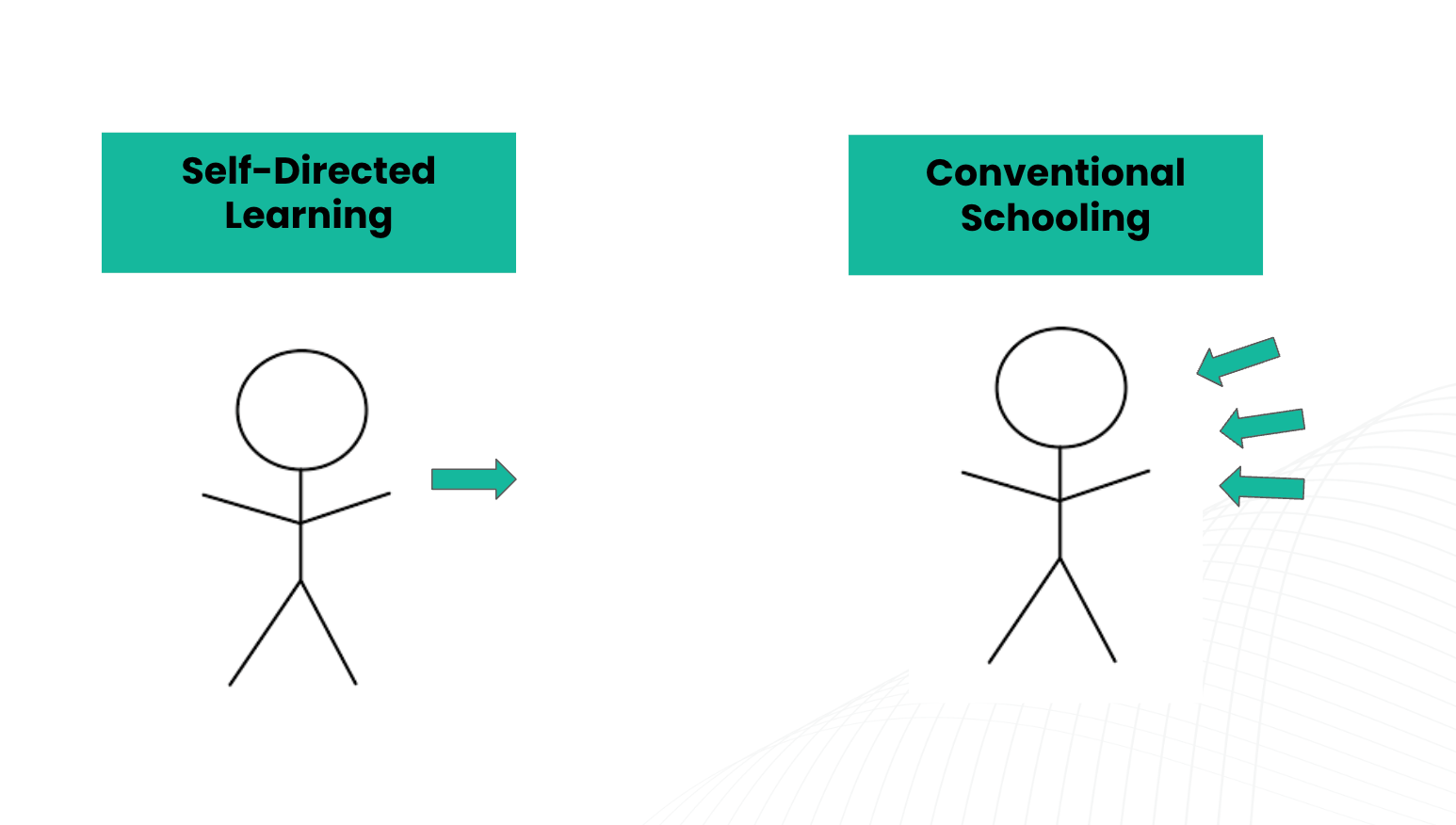
This is SDL in its most basic form, represented by direction arrows. In a self-directed environment, the arrow starts with the individual (Aristotle’s man who desires to know) and moves outwards, towards resources, opportunities, peers, and teachers. In most conventional school settings, the arrows are external (standards, curricula, assessments, etc.) and are foisted upon the individual. We then wonder why that individual lacks intrinsic motivation to learn.
This simple definition of SDL falls short, though, of cultivating the type of flourishing education I’ve been arguing for.
At the Institute for Self-Directed Learning, we landed on a definition that tried to address what we felt was missing from the others:
Self-directed learning is when learners, in the context of an interdependent community of peers, trained educators, and caring adults, choose the process, content, skills, learning pathways, and outcomes of learning, with the guidance, accountability, and support of others, in service of finding a calling that will change their communities and the world.
This definition puts the learner in community, and it gestures toward a purpose larger than the individual. I’d like to add some contour to it, in a way that infuses the concept of eudaimonia this series has been exploring.
I think part of the problem is the label itself.
Here’s where I think the phrase “self-directed learning” can get misconstrued.
First, it implies that learning can happen alone. It can’t, at least not in any fully human sense. Lev Vygotsky made this case a century ago: we learn first in relationship, and only later internalize what began as a social act. Even the lone reader is in conversation with an author. We are social beings who make meaning together, and a label that centers the self can quietly undermine that.
Second, it privileges the individual over the community. The “self” in self-directed learning frames the whole enterprise as being for the learner’s benefit. But as I’ve argued throughout this series, education exists for society too. Dewey called education “the social continuity of life.” A vision of learning that’s purely about what I want, what I care about, and what benefits me leaves out the obligation we have to each other.
Third, the word “learning” is ethically neutral. You can learn to play piano or learn to pick pockets. Learning is a process; it doesn’t tell you what the process serves. Paulo Freire warned that education is never neutral: it either forms people for the world as it is or frees them to remake it. A definition that centers learning without asking learning for what is missing something essential.
For these reasons, I’ve arrived at a different framing. I call it Eudemonic Self-Directed Learning, or ESDL. It takes the concept of SDL and layers on top a view of human flourishing. I posit this mostly as a philosophical exercise, not a practitioner-friendly definition.
The name reaches back to Aristotle. Eudaimonia is usually translated as “happiness,” but it means something richer: the kind of happiness that comes from a life well lived, from growing in virtue, from being embedded in a community working toward something good together. Regular readers will recognize it as the thread running through this whole series.
Here’s the definition I propose:
ESDL is the process in which human beings, growing in internal virtues, external skills and abilities, knowledge, and wisdom within a community, freely choose a life that leads to their own happiness and collectively participate in creating a society in which all can flourish.
That’s a mouthful. Let me take it apart.
“Growing in internal virtues.” This is the Aristotelian piece. Aristotle argued in the Nicomachean Ethics that virtue isn’t taught by lecture; it’s formed by practice, the way we learn to build by building. ESDL is concerned with character, not just competency. The goal isn’t only what you know or what you can do, but who you’re becoming.
“External skills and abilities.” Practical capability still matters. Flourishing requires the ability to navigate the world, earn a living, maintain relationships, and solve problems. ESDL doesn’t pretend these things are irrelevant.
“Knowledge and wisdom within a community.” Wisdom isn’t developed alone, and it isn’t neutral. It emerges from living among others, wrestling with real problems alongside real people. Community isn’t just the setting for learning; it’s part of the learning itself.
“Freely choose a life.” Agency is still central. Choice, responsibility, and real ownership of one’s own path are non-negotiable. But the freedom here has a direction. It’s oriented toward a good life, not just an autonomous one.
“Collectively participate in creating a society in which all can flourish.” This is the piece most existing SDL definitions leave out. The goal isn’t just my flourishing. It’s a society where flourishing is possible for everyone. That takes more than personal development. It takes citizens who are invested in the common good.
What does ESDL look like in practice? The previous article covered the design principles, so I’ll keep this short. Three things are central.
The first is intentional character development. ESDL environments don’t leave character to chance. They ask explicitly: what kind of human beings are we trying to help grow? And they design around the answer. The Forest School has a Profile of a Graduate that includes not just academic disciplines but character traits like empathy and trust. To graduate, a learner has to demonstrate those traits through real-world evidence.
The second is genuine individual agency. Learners need real choices with real consequences. Some schools offer a simulation of choice (pick from these three approved projects) and call it agency. Actual ownership looks different. In some environments, learners help write the rules they live under. In others, they design their own learning plans. What matters is that the agency is authentic.
The third is democratic community. ESDL requires that learners regularly practice the skills of living together: debate, compromise, feedback, and accountability to each other. Dewey insisted that democracy has to be learned by living it, that it’s “a mode of associated living” before it’s a form of government. A school where all decisions flow from adults isn’t preparing children for democracy. It’s practicing benevolent autocracy and hoping something different emerges on the other side of graduation.
ESDL isn’t really a model to replicate; think of it more like a direction arrow.
I’ve spent enough time in these schools to know they’re messy. Real self-governance among children is slow and frustrating. Character development doesn’t happen on a clean timeline. Equity is hard to achieve and easy to undermine. Any honest account of SDL environments has to reckon with the ways they fall short of their own ideals. Mine included.
But the direction matters. An education system pointed toward flourishing, individual and collective, grounded in wisdom and character, oriented toward democratic engagement, is pointed somewhere worth going. Even imperfect progress in that direction beats excellent execution of a system pointed the wrong way.
Next: Three questions that will determine whether this vision of education scales, or stays on the margins.
I think there's another layer to this. We begin life dependent, then hopefully grow into independence, but the goal isn't to stay there. It's through becoming an individual that we're capable of genuine interdependence. Without that middle step, community can easily become dependence rather than a community of whole people choosing to contribute.